
We are happy to help you
57931
In stock
Only %1 left
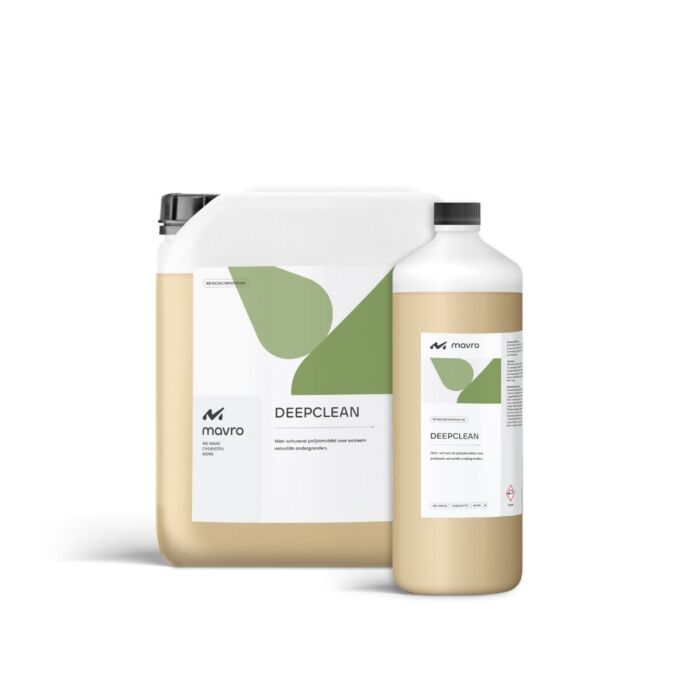
Deep Clean
As low as €17.95
A non-abrasive polish for extremely dirty surfaces.
PRODUCT DESCRIPTION
Deep Clean is a cleaning agent with strong cleaning and polishing properties
Deep Clean is very suitable for application on scratch-sensitive surfaces due to its very fine granules.
Deep Clean is very suitable for on-site cleaning of heavy fouling on a range of coatings, such as sheet piles.
USE
Deep Clean is applicable on practically all surfaces, including scratch-sensitive surfaces such as RVS, plexiglass, polycarbonate, glazed tiles, plastics and coatings.
CHARACTERISTICS
• Scratch-free polish
• Safe for practically all surfaces
• Powerful cleaning properties
• Easy to use
PACKAGING
1 and 5 L.
OPERATING INSTRUCTIONS
1. Apply Deep Clean undiluted with a damp microfiber cloth or power sponge.
2. Work the product through with a cloth or sponge to remove contamination and scratches.
3. Wipe with a clean microfiber cloth and rinse with water.
4. Repeat the procedure if necessary.
APPLICATION CONDITIONS
Deep Clean can be used in all dry weather conditions. Low temperature may delay the efficacy. Do not apply on hot surfaces or in direct sunlight.
THEORETICAL CONSUMPTION
Consumption is 10-20 m2/L. Consumption is greatly influenced by the degree of fouling and the structure of the surface.
STORAGE AND STABILITY
Can be kept for at least 12 months in original unopened packaging.
Store in a dry, cool and frost-free place.
SAFETY PRECAUTIONS
Causes serious eye irritation. Avoid skin and eye contact, wear suitable gloves and safety goggles. If in doubt, always consult the safety data sheet or our R&D department.
Consumption is 10-20 m2/L. Consumption is greatly influenced by the degree of fouling and the structure of the surface.

Related Products
Check items to add to the cart or
-
-
 PowerspongeA melamine sponge for fast graffiti removal, cleaning and for the application of NitoCoat and NitoGuard (Glass and Plastic).€1.95
 -
 NitowaxHigh-quality polishing, cleaning, and preserving agent for weathered substrates. For application on non-porous façade finishing materials such as plastic, water jackets, volkern and façade cladding and aluminum. also removes black puncture marks.As low as €31.50